Rain protection sounds essential for Europe, yet only 6 of 37 travel walking shoes were listed as waterproof. The bigger win is finding a pair that stays comfortable after hour four on hard streets. We use this five-step check to match your shoes to your route, feet, weather, and suitcase.
Some links in this article are affiliate links. If you book through them, we earn a small commission at no extra cost to you. We only include affiliate links for things we’d recommend regardless.
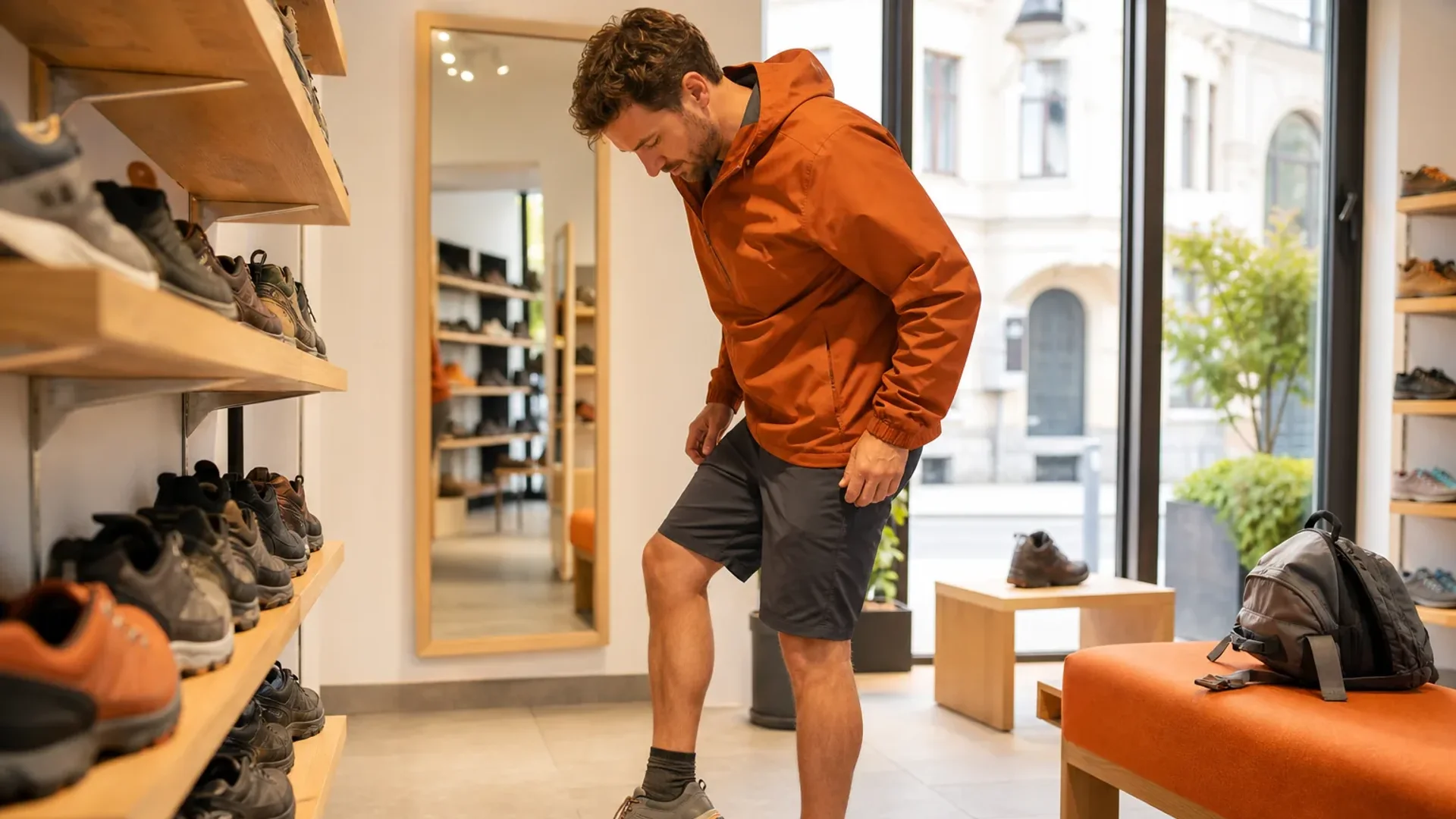
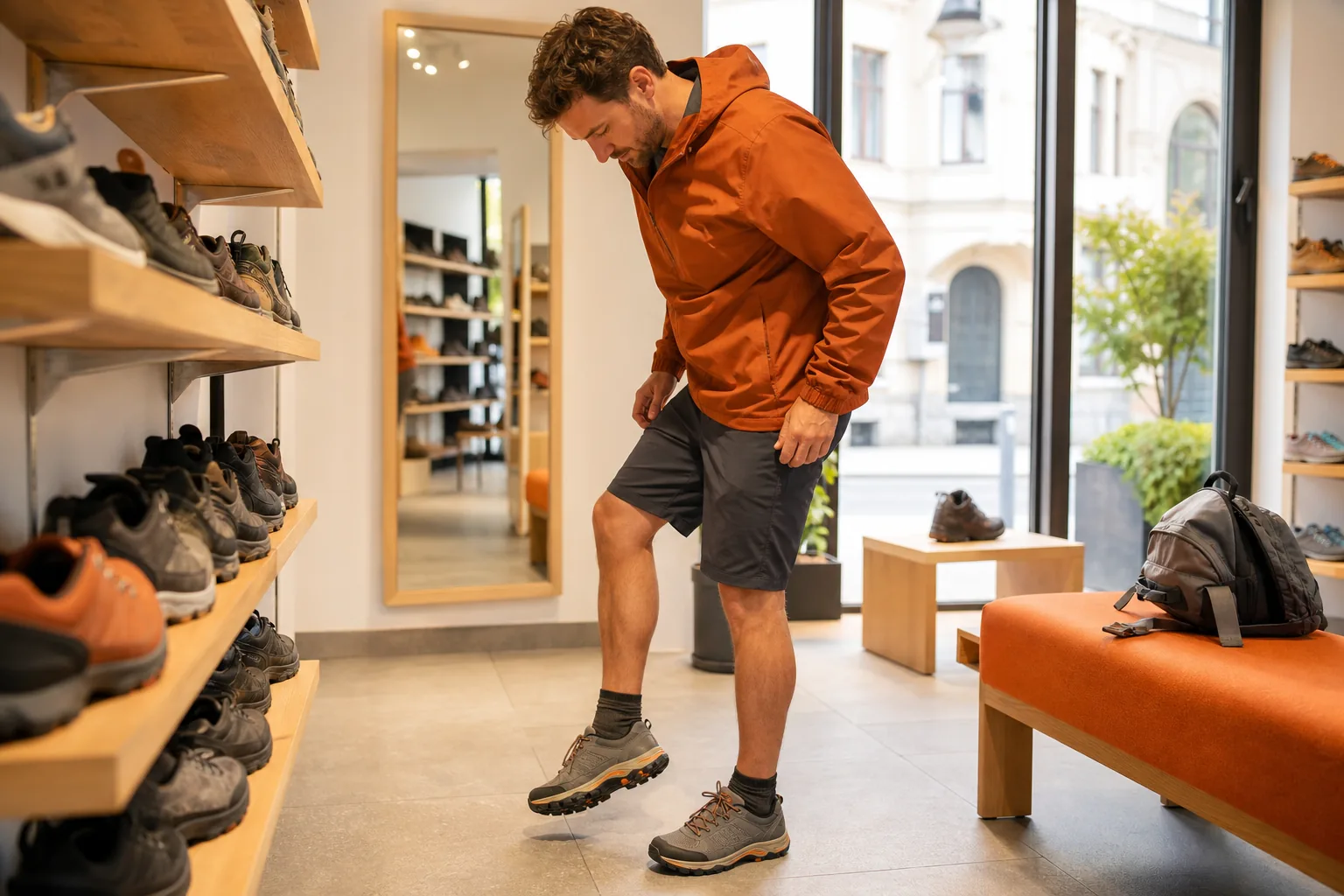
Step 2: Test fit, support, and comfort before you leave
The right shoes for Europe travel should feel secure at the heel while leaving your toes room to spread. A soft first impression is not enough. Your feet can change size during the day, and a small rub can become a large blister by dinner.
Measure both feet in the evening, when they have had time to swell. Trace each foot on paper while wearing the socks you plan to use. Check the brand’s size chart against your length and width. If you’re between sizes, sizing up is usually safer than squeezing into the smaller pair.
Walk around the shop for at least ten minutes. Try stairs if you can. Bend the shoe at the forefoot. Your heel should not lift sharply, while your toes should not touch the front when you walk downhill or step down.
Support is personal. A moderate amount of cushioning can soften hard pavement, but too much can reduce ground feel. A flexible sole may help on uneven streets, while a firmer sole can feel steadier if your ankles need more help.
Be careful with zero-drop shoes, where the heel and toes sit at the same height. If you normally wear a raised heel, switch slowly. Your calves and Achilles tendon may need time to adjust. A shoe that feels natural to one traveler can cause strain for another.
Plantar fasciitis is pain linked to the thick band of tissue along the bottom of the foot. The Wikipedia overview of plantar fasciitis describes the condition and its common symptoms, but persistent foot pain deserves advice from a qualified clinician.
Don’t test new shoes on your flight day. Wear them on a short walk first, then a longer walk with the socks you will pack. Check for heat, pressure across the top of the foot, heel slip, and rubbing at the little toe.
We also suggest trying the shoes late in the day. If they feel tight then, they are likely to feel worse after a full day of sightseeing. By now, you should have one pair that feels good after movement, not just while standing still.
Step 3: Compare the best shoe types for your route
The best walking shoes for Europe travel depend on the ground under your feet. Compare shoe types by job, not by marketing language. A city sneaker does not need the same sole as a trail shoe, and a sandal should not be your only option in cold rain.
Shoe type
Works well when
Trade-off
Examples
City walking sneaker
Most days are pavement, tile, and short transit walks
Less protection in deep rain or rough paths
On Cloud 6, Icebug Mosi RB9X
Highly cushioned shoe
You expect long hours on hard ground
Can feel bulky or less responsive
HOKA Clifton 10, On Cloudsurfer 2
Trail or mixed-terrain shoe
Your route includes gravel or light trails
More tread may feel clumsy on smooth floors
HOKA Transport 2, Cloudsurfer 2 Trail
Sandal
Warm, dry days matter more than full coverage
Limited use in cold or wet weather
Birkenstock Arizona Soft Footbed
Barefoot-style shoe
You already know you like a wide toe box and low heel
Needs a gradual change if you’re new to it
Xero Shoes Prio
Weight can shape your choice. Among the ten entries with weight data, the average was 17.35 ounces. The range ran from 14.6 ounces for the Nike Pegasus 41 to 23.4 ounces for the HOKA Bondi SR. That difference may not sound large, but it adds up when you carry the pair through airports or pack it in a small bag.
Waterproofing also has a trade-off. The HOKA Transport 2 was one of the waterproof options, while the On Cloudsurfer 2 and HOKA Clifton 10 were not. A waterproof label cannot tell you how the shoe feels in heat or how fast the inside dries after a leak.
Price does not settle the question. Whitin shoes were listed around $30 to $40, while the Flat sandals from Margaux were listed at $280. The more expensive pair was not waterproof. Fit and use should decide the spend.
Flexibility can make sense for uneven streets, but don’t chase a bendy sole if your foot needs more structure. Your route and your body get the final vote.
Step 4: Build a rain and outfit plan without overpacking
Rain changes the shoe plan, but it does not always justify a waterproof walking shoe. Waterproofing can help during steady rain, yet many travelers only need a way to handle short showers and wet sidewalks.
Check your forecast close to departure, then ask how long you will be outside. If rain is likely all day, a waterproof model deserves more weight in the decision. If showers are brief, a comfortable non-waterproof shoe may work with a second pair that dries easily.
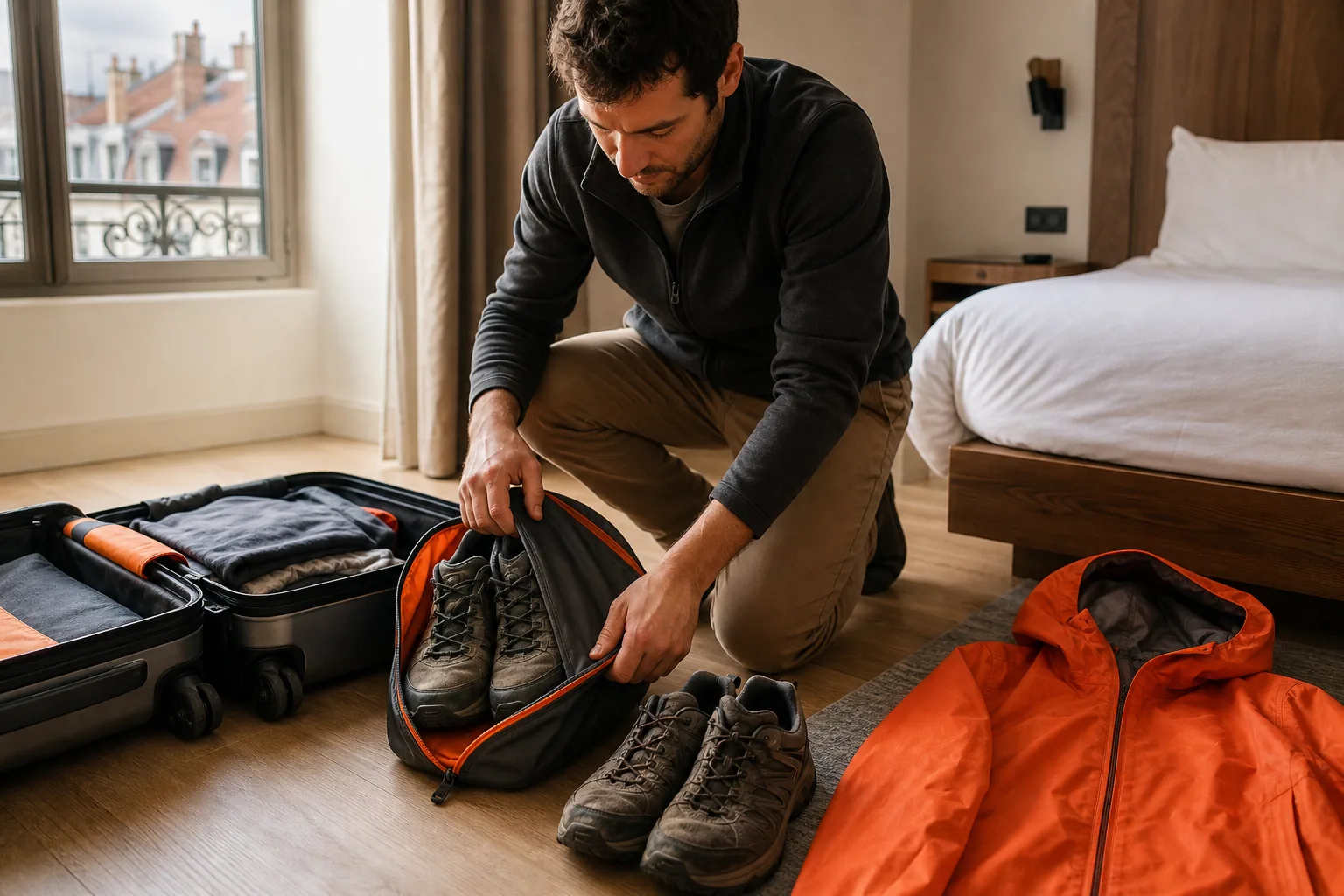
We like a two-pair rule for most trips. Wear the bulkier pair in transit. Pack the lighter pair in a shoe bag. Give each pair a separate job, such as long walks for one and downtime or wet areas for the other.
Keep the outfit plan simple. A neutral sneaker can work with trousers, jeans, and casual dresses. Sandals can cover hot days, but they should not become your only walking option if your route includes cold rain or rough ground.
The basic definition of waterproofing helps explain the limit: water resistance and full protection are different claims. Read the product details closely instead of treating a water-resistant label as a promise of dry feet in every storm.
Pack enough socks to manage wet weather without adding another shoe. A small laundry plan can save more space than a third pair. If your feet run hot, choose a shoe with enough room for airflow rather than adding extra padding to a tight fit.
Pro Tip: Wear the shoe that takes up the most room on the travel day. Pack the flatter pair, and keep both away from clean clothes with a simple shoe bag.
Skip the dress shoe that works for one dinner unless the itinerary truly requires it. Most travelers get more value from a pair that covers the walk to dinner too.
Step 5: Break in your shoes and make the final packing decision
Break-in time is part of the purchase price. A pair that needs several walks before it feels right should not meet your feet for the first time beside a foreign train platform.
Start with 20 to 30 minutes at home. Increase the time on the next walk if you have no hot spots. Wear your travel socks, carry the bag you plan to use, and include stairs or a hill if your route has them.
Pay close attention to the first sign of trouble. Red skin at the heel means friction. Numb toes suggest pressure or poor width. A burning forefoot can point to a poor fit or a heel-to-toe shape that does not suit you.
Some shoes improve quickly. Testing notes for the HOKA Transport 2 described a stiff first walk, followed by better comfort as the upper and midsole loosened. That does not mean every stiff shoe will become comfortable. Give it a fair test, but set a limit.
Use this final check:
Can you walk for at least an hour without a hot spot?
Does your heel stay put when you step down?
Do your toes have room after your feet swell?
Does the tread match your route?
Will the pair work with most of your planned clothes?
If you answer no to any of those questions, keep testing before you pack. Return rules are worth checking before you wear the shoes outdoors. A bargain is not a bargain if the pair sits unused after one painful walk.
For a Paris trip, the same rule applies to flats and boots. Wear planned shoes before departure, especially when you expect long days on foot. We agree. The guides won’t feel the pressure point on your little toe. You will.
Choose the pair that stays calm after the longest test. That is a better signal than a soft in-store feel or a dramatic waterproof claim.
FAQ about walking shoes for Europe travel
What are the best walking shoes for Europe travel?
The best walking shoes for Europe travel are the pair that fits your feet after several hours, grips your route, and works with the weather. A cushioned sneaker suits hard city streets, while a mixed-terrain shoe fits gravel and light trails. Don’t buy for the label alone. Test the exact pair with your travel socks.
Do I need waterproof shoes for Europe?
You don’t always need waterproof shoes for Europe. Choose waterproof protection when steady rain is likely or your route stays outdoors. For short showers, a second pair may be more useful.
Are sneakers good for walking on cobblestones?
Sneakers can work well on cobblestones if they have enough cushioning, a secure heel, and a sole that bends at the forefoot. Very soft shoes may feel unstable, while very stiff shoes can make uneven streets tiring. Test your pair on stairs and hard ground before you leave.
How long should I break in travel shoes?
Break in travel shoes over several walks rather than relying on one short try-on. Start with 20 to 30 minutes, then add time when your feet feel fine. Stop if you find rubbing, numbness, or sharp pressure. A shoe that still causes trouble after repeated tests is the wrong shoe for your trip.
How many pairs of shoes should I pack for Europe?
Two pairs cover most Europe trips. Wear the bulkier walking pair in transit and pack a lighter pair for downtime, warm weather, or wet areas. Add a third pair only when your itinerary has a clear need, such as a formal event or serious trekking. Every pair should earn its space.
Final Thoughts: Pack the pair you can trust all day
We recommend choosing the shoe that still feels good after your longest test walk, then adding rain protection only if your route needs it. Set aside one afternoon before departure, wear both pairs with your travel socks, and let your feet make the final call.
The best earplugs for flying depend on your problem. Loop Quiet 2 for noise and sleep, Mack's Flightguard or Alpine FlyFit for ear pressure.
Verdict: Loop Quiet 2 ($24.95) is the best earplug for flying if cabin noise and sleep are your problem. Mack's Flightguard ($11.99) and Alpine FlyFit ($16.95) are the picks if your ears hurt on descent, because they are built with pressure-regulating filters.
The best travel blanket for most people is the 0.79 lb Rumpl Travel Puffy. Three picks compared on weight, price, and warmth, plus a scarf trick.
Verdict: The Rumpl Travel Puffy ($89.95, 0.79 lb, packs to 4 by 10 inches, 3-year warranty) is the best travel blanket for most people. Cocoon's COOLMAX blanket ($49.95) is the cheaper, lighter-feeling pick, and Cocoon's merino and silk blanket ($149.95) is the one for the coldest cabins.
The best luggage scale for most travelers is the $10.99 Etekcity EL11. Five scales compared on capacity, price, battery, and who should skip each.
Verdict: The Etekcity EL11 ($10.99, 110 lb capacity, 4.8 oz, 2-year warranty) is the best luggage scale for most travelers. Freetoo is the lighter runner-up, Samsonite is the pick if you want a built-in tape measure, and the battery-free Travelon is for people who never want to replace a battery.