Most travel backpacks called waterproof are only water-resistant. That difference matters when your bag sits on a wet boat deck or gets caught in a hard storm. Capacity, weight, prices, and water protection can help you choose a pack that fits your trip, not a marketing label.
We checked spec pages and reviews for 5 backpacks marketed as waterproof: Wandrd Prvke, Tortuga Outbreaker, Monos Metro, Matador Beast28, Boundary Supply Errant Pack. Three of the five use the word waterproof in their marketing copy, but none list a numeric rating such as IPX or hydrostatic head. Independent write-ups on the Prvke and the Outbreaker both concluded the packs are water-resistant, not waterproof, despite that marketing wording. Across these 5 packs, none disclosed a number behind its water claim, so the word waterproof alone says little about a downpour.
Step 2: Match backpack capacity to your travel length and packing style
Capacity is the quickest way to narrow the field of waterproof backpacks for travel. Most packs in our comparison sit between 28 and 40 liters, even though several 45-liter models appear in the same market.
Start with your packing habit. If you pack light and wash clothes during a trip, 20 to 30 liters may cover a long weekend. The NOMATIC Travel Pack 20L weighs 1,860 grams and is listed as water-resistant. Its smaller 14L version weighs 1,588 grams and suits a compact setup.
Capacity and weight are useful details when comparing packs instead of relying on photos. A 20-liter pack can work for one to three days, but it leaves little room for bulky shoes or cold-weather layers.
For a week, look at the 30 to 40-liter range. The Cotopaxi Allpa 35L has a 35-liter capacity, weighs 1,332 grams, and is listed as water-resistant. The REI Co-op Ruckpack 30 has 30 liters, weighs 822 grams, and uses a rain cover plus DWR treatment. Its lower weight may help on long walking days.
At 40 liters, the Osprey Farpoint 40 weighs 1,542 grams and uses DWR-treated polyester. These sizes suit travelers who want one main bag without pushing into checked-luggage territory.
A 45-liter pack gives you more room, but it can tempt you to fill every corner. The Patagonia Black Hole MLC 45 weighs 1,644 grams and is listed at $249. The Peak Design Travel Backpack 45L weighs 1,588 grams and is listed at $300. Capacity helps only if you can still lift the loaded pack with ease.
Trip pattern
Useful capacity
What to watch
One to three days
14L to 20L
Limited room for shoes and cold layers
Light one-week trip
30L to 35L
Pack cubes can waste space if the bag has fixed dividers
Longer one-bag trip
40L to 45L
Check airline size rules and loaded weight
Wet boat or outdoor use
Any size
Confirm sealed seams and closure type
Across the larger comparison, the average capacity was 30.2 liters. Weight data was available for only 37% of entries, yet the median weight among reported packs was 1,565 grams. More room often means more structure and more weight, so don’t buy liters you won’t use.
Step 3: Compare how each pack carries on a real travel day
The best waterproof backpacks for travel still need to feel good after a missed connection. Test the pack against the day you actually have: airport security, stairs, a crowded train, and a walk to your lodging.
First, check how the load sits. A hip belt shifts weight away from your shoulders.
Next, look at access. A clamshell opening lets you see most of the bag at once. That works well for packing cubes. A large single space gives you more freedom for odd-shaped items, but small gear can disappear at the bottom. More pockets help until you forget where you put the charging block.
Shoulder straps need enough padding for the load. Back panels also affect heat during a long walk. The Bellroy Lite Travel Pack 30L weighs 950 grams and uses DWR-coated nylon, making it a lighter choice on paper. The Aer Travel Pack 4 weighs 1,769 grams, so its carry system needs to justify that extra load for your body.
Don’t ignore grab points. A top handle helps on airport security trays. A side handle helps when pulling the pack from an overhead bin. Compression straps can reduce bulk, but they may block a laptop zip or slow access when you’re rushing to a gate.
Water protection also changes how you carry. A rain cover can shield the outer fabric, but wind can lift it and water can still reach exposed zips. A coated liner gives another layer of defense. Neither one means you should submerge the bag.
Pro Tip: Load the pack with your usual laptop, shoes, and clothes. Walk for 15 minutes before buying. Empty weight tells you less than loaded balance.
General fit guidance can help you remember that body shape affects comfort. A use that fits one torso may press badly on another. Buy from a seller with a clear return policy, then test the pack indoors with the tags intact.
Step 4: Choose the best waterproof backpack for your specific trip
Choose water protection based on the worst exposure your trip can bring. City rain, a wet airport floor, and an open boat need different levels of defense.
For normal city travel, water-resistant fabric may be enough. The Osprey Farpoint 40 uses DWR-treated polyester. The Bellroy Lite Travel Pack 30L uses DWR-coated nylon. These finishes can shed light rain, but they are not a promise that your electronics will stay dry during prolonged exposure.
For mixed city and trail trips, the REI Co-op Ruckpack 30 gives you a PU-coated rain cover plus DWR treatment. That setup adds a backup layer when the weather turns. Its 822-gram weight also keeps the bag from becoming the heaviest thing you carry.
For a large one-bag setup, compare the Peak Design Travel Backpack 45L and Patagonia Black Hole MLC 45. The Peak Design model is listed at $300 and uses a double PU-coated 900-denier waterproof liner. The Patagonia model is listed at $249 and uses TPU-coated material. Both are still described as water-resistant in the source data, so don’t treat either as a dry bag.
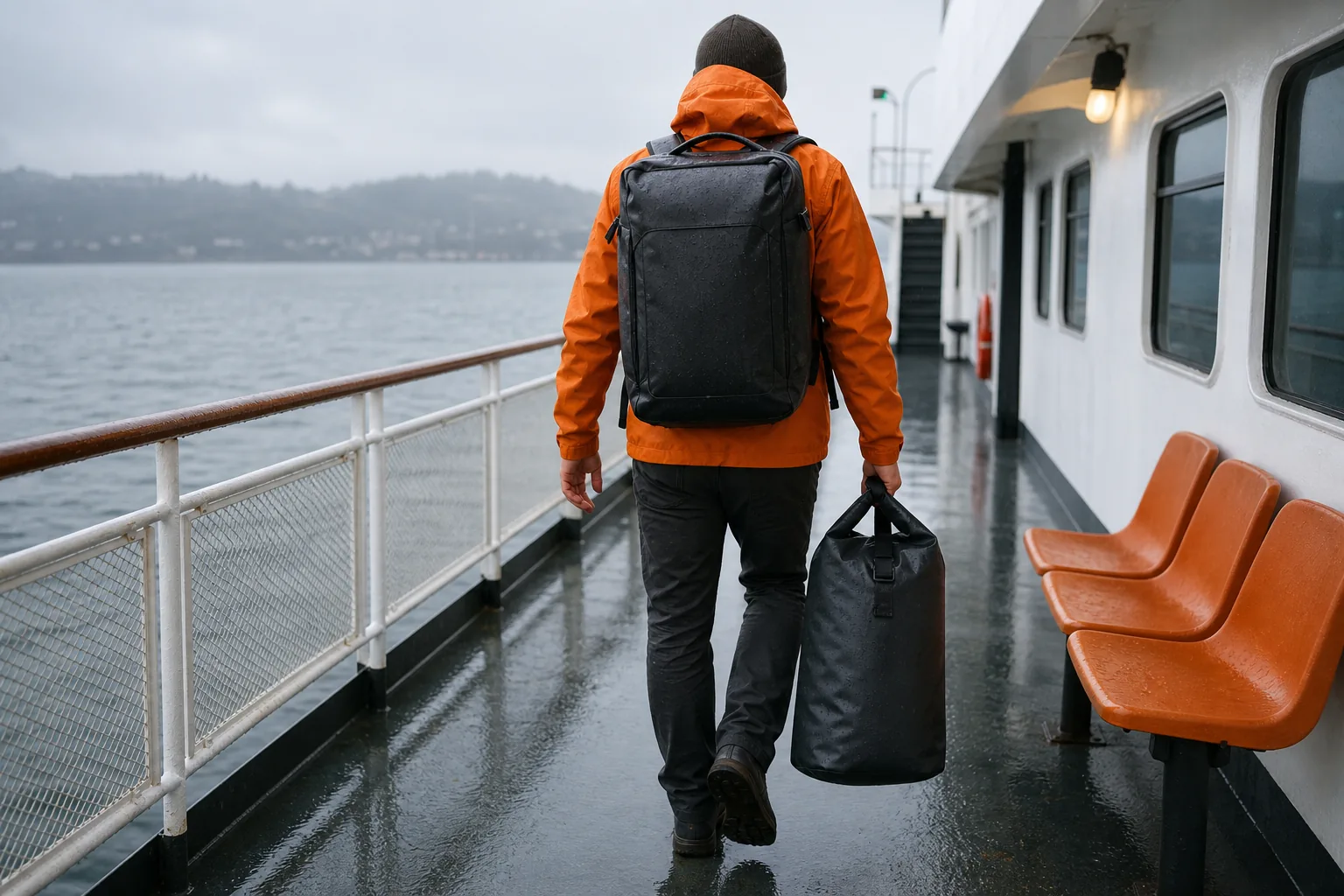
For a true wet-use scenario, consider a separate dry bag inside or instead of a travel backpack. A roll-top bag gives stronger water protection when properly closed, but it usually sacrifices laptop padding, outside access, and tidy organization. That is a fair trade on a boat. It can be annoying in an airport.
For tech-heavy travel, the Salkan Backpacker is listed at 45 liters and $315, with a rain-resistant polyester build and space suited to laptop or camera gear. It may make sense when organization matters more than low weight. It doesn’t change the basic rule: rain-resistant is not submersible.
Use your itinerary as the test. A hotel-to-airport trip in a wet city needs one answer. A trip with ferries, paddle boats, or exposed luggage needs another. The guides won’t always make that split clear, so we do.
Step 5: Check the fit, protection, and price before you buy
Before you buy, check the exact product page for the current material, closure, weight, and return terms. Backpack names often cover several sizes, and a small change in capacity can change the frame and carry feel.
Test fit with the load inside. Put the heaviest item close to your back. Tighten the shoulder straps before adjusting the sternum strap. If the pack pulls backward, the load sits too low or the bag is too full.
Then inspect the weak points. Look at the zipper path, seam tape, roll-top closure, and pocket openings. Water usually gets in through an opening, not through the center of a coated panel. A rain cover won’t protect a laptop sleeve if water runs behind it.
Price can mislead you here. The prices in our collected data ranged from $109 for the REI Co-op Ruckpack 30 to $300 for the Peak Design Travel Backpack 45L. The median listed price across the wider research set was $249, but only 11 of 49 entries included price information.
That gap makes value hard to judge. A $249 water-resistant pack may be worth it for its use, layout, and warranty. It may be a poor buy if your only goal is keeping clothes dry during a boat ride. In that case, a low-cost dry bag may protect better.
Check the airline’s carry-on rules before choosing 45 liters. The Patagonia Black Hole MLC 45 is described as a tight fit for some carry-on limits. A gate check can expose your bag to rain and rough handling, which defeats the point of paying for extra weather protection.
Finally, compare the cost with the items inside. A laptop, camera, passport, and medication deserve a backup plan. Put sensitive gear in waterproof pouches even when the backpack claims strong protection.
If you use points for the flight, our guide to credit cards for international travel can help you compare travel protections and fees. Keep the backpack decision separate from the card decision. A reward won’t make a leaky zip dry.
Don’t pay a premium for the word waterproof alone.
FAQ: Best Waterproof Backpacks for Travel
Are travel backpacks actually waterproof?
Most travel backpacks are water-resistant rather than fully waterproof. DWR coatings, TPU fabric, PU coatings, and rain covers can slow water, but they may not protect against immersion. If your bag could sit on a wet boat deck, use a sealed dry bag or place sensitive gear inside waterproof pouches.
What size backpack is best for a week of travel?
A 30L to 40L backpack suits many week-long trips, depending on how lightly you pack. A 35L pack can work with repeat outfits and packing cubes. Choose 40L if you need a second pair of shoes or bulky layers, but check the loaded weight before leaving home.
Is a waterproof backpack worth it for flying?
A water-resistant backpack is usually worth it for flying when you walk through rain or carry electronics between terminals. Fully waterproof construction may be unnecessary for a hotel-to-airport trip. Spend more on fit and access first, then add a small dry bag for a laptop or camera.
What is the difference between waterproof and water-resistant backpacks?
Water-resistant backpacks repel limited rain, while waterproof bags aim to block water through fabric, seams, and closures. The terms are used inconsistently across travel gear. Look for a stated rating, sealed seams, and a closure designed for wet conditions instead of trusting the product title.
Can I use a dry bag as a travel backpack?
You can use a dry bag for wet trips, but it may lack padding, pockets, and a supportive use. That makes it less pleasant for airports or long city walks. A dry bag works well as an inner liner when you need strong water protection without giving up the structure of a travel pack.
The pack I would take
I recommend choosing a 30L to 40L water-resistant travel pack for normal city trips, then adding a dry bag for serious exposure. Before ordering, load it with your actual gear and check the closure points.
The best earplugs for flying depend on your problem. Loop Quiet 2 for noise and sleep, Mack's Flightguard or Alpine FlyFit for ear pressure.
Verdict: Loop Quiet 2 ($24.95) is the best earplug for flying if cabin noise and sleep are your problem. Mack's Flightguard ($11.99) and Alpine FlyFit ($16.95) are the picks if your ears hurt on descent, because they are built with pressure-regulating filters.
The best travel blanket for most people is the 0.79 lb Rumpl Travel Puffy. Three picks compared on weight, price, and warmth, plus a scarf trick.
Verdict: The Rumpl Travel Puffy ($89.95, 0.79 lb, packs to 4 by 10 inches, 3-year warranty) is the best travel blanket for most people. Cocoon's COOLMAX blanket ($49.95) is the cheaper, lighter-feeling pick, and Cocoon's merino and silk blanket ($149.95) is the one for the coldest cabins.
The best luggage scale for most travelers is the $10.99 Etekcity EL11. Five scales compared on capacity, price, battery, and who should skip each.
Verdict: The Etekcity EL11 ($10.99, 110 lb capacity, 4.8 oz, 2-year warranty) is the best luggage scale for most travelers. Freetoo is the lighter runner-up, Samsonite is the pick if you want a built-in tape measure, and the battery-free Travelon is for people who never want to replace a battery.