A money belt is the only pickpocket countermeasure that genuinely works: the thief cannot reach what they cannot see. But most money belts on the market are uncomfortable enough that travelers stop wearing them by day two, which makes them worse than useless. Here are four that stay comfortable across a long travel day, what to look for, and which one to buy first.
Some links in this review are affiliate links. Intastravel may earn a small commission at no extra cost to you. It does not change which products we pick.
What actually matters in a money belt
Wearability under clothes. A money belt you pull off at a cafe is a money belt that eventually stays in the hotel room. The best ones are thin enough to wear all day without the outline showing through a shirt and smooth enough against skin that you forget they are there.
Airport compatibility. Many travelers do not realize that a metal buckle means removing the belt at security — which defeats most of the point. Look for a plastic or polypropylene buckle, or a stretch design with no buckle at all.
Capacity for what you actually carry. Passport, folded bills, one or two cards. That is the entire job. Resist the temptation to carry your whole wallet in a money belt; use it for your backup card and emergency cash, keep your everyday spending in an accessible pocket.
RFID blocking (real vs. marketing). RFID theft is real but overstated as a threat. Physical pickpocketing is far more common than card scanning. That said, if you are traveling through dense metro systems and tourist crowds, RFID blocking costs nothing extra on most modern belts and does not hurt.
The four best money belts for travel
Best overall: Pacsafe Cashsafe Anti-Theft Travel Wallet Belt
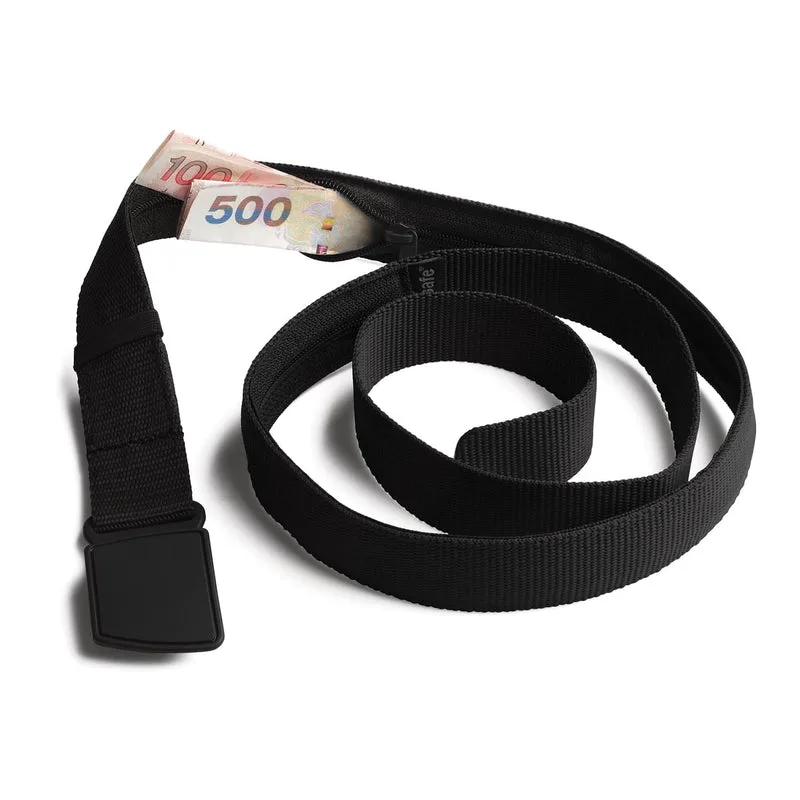
Image: Pacsafe
$19.95 — pacsafe.com
The Cashsafe is the money belt I point most first-time users toward. At $19.95 it is priced low enough that replacing it is not a concern, but it is built from durable PP webbing that has nothing in common with the cheap nylon belts on Amazon.
The belt is 27.6 inches long by 1.2 inches wide and a tenth of an inch thick — genuinely flat against the body. The hidden storage pocket sits against your skin and closes with a concealed zipper. The buckle is plastic, which means it passes through airport metal detectors without removal. The waist range covers 18.3 to 46.5 inches and the weight is 0.15 pounds.
One limitation: Pacsafe does not list RFID blocking for the Cashsafe. If that matters to you specifically, one of the belts below addresses it. For most travelers the Cashsafe’s combination of thin profile, metal-free hardware, and proven build quality makes it the right starting point.
Top Pick: Pacsafe Cashsafe — $19.95
The flattest profile of any belt here, metal-free, and priced for long-term use without worry.
Check price at Pacsafe
Best RFID-blocking belt: Eagle Creek Undercover RFID Money Belt
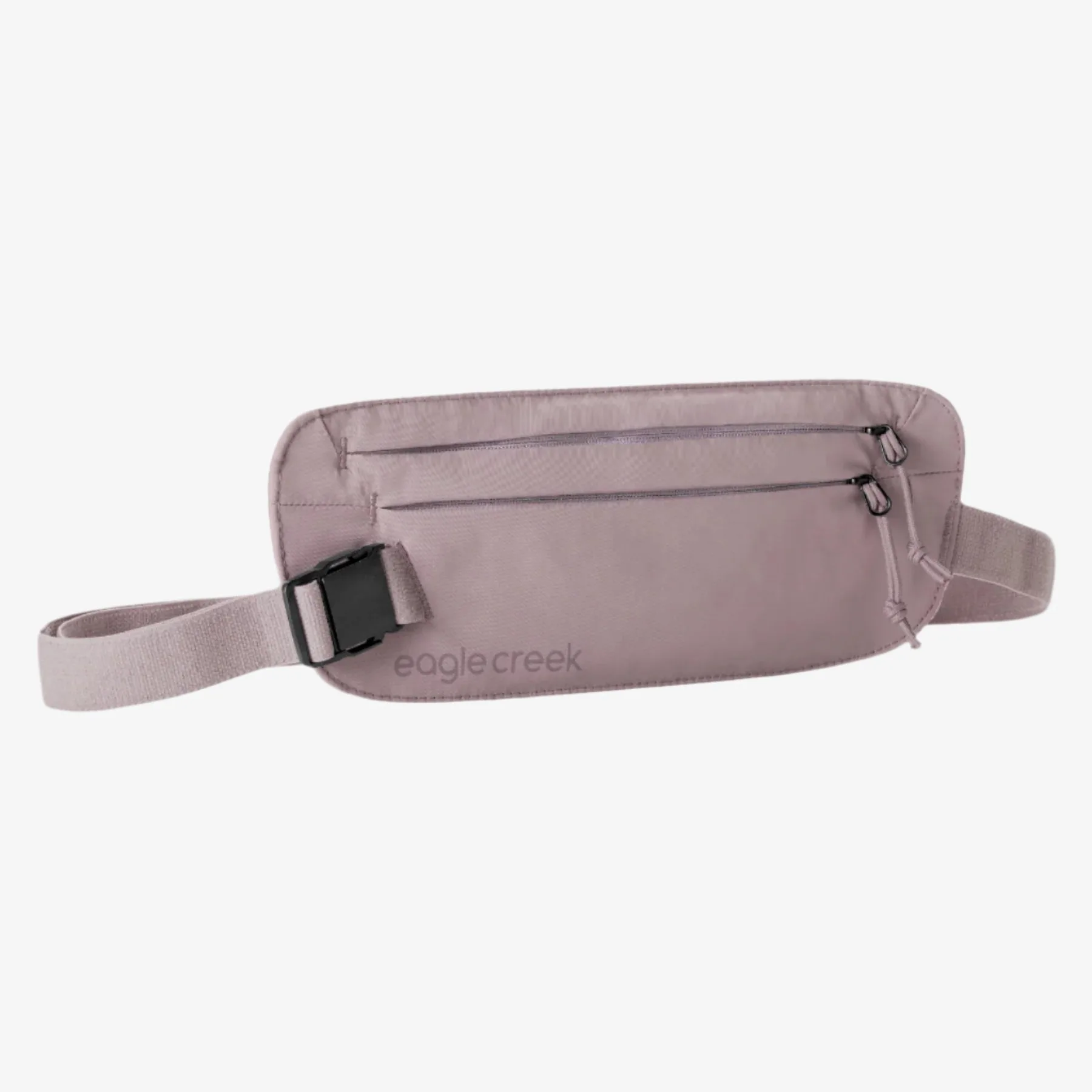
Image: Eagle Creek
$35.00 — eaglecreek.com
Eagle Creek is the category’s most recognized name, and the Undercover RFID Money Belt earns that reputation. It is made from 100% recycled nylon ripstop with a moisture-wicking back panel that breathes better than most competitors. Two zippered mesh pockets hold a passport in one and folded currency in the other, which keeps documents separated and easier to access.
The adjustable strap fits waist sizes from 30 to 60 inches, and the soft elastic waistband with protected buckles makes it comfortable for full-day wear. RFID blocking is built in, not a coating that wears off.
At $35 it costs $15 more than the Pacsafe. If you want the added security of RFID blocking and you prefer an established brand with wide retail availability, the Eagle Creek is the natural upgrade.
Check price at Eagle Creek
Best for minimalists: Venture 4th Travel Money Belt
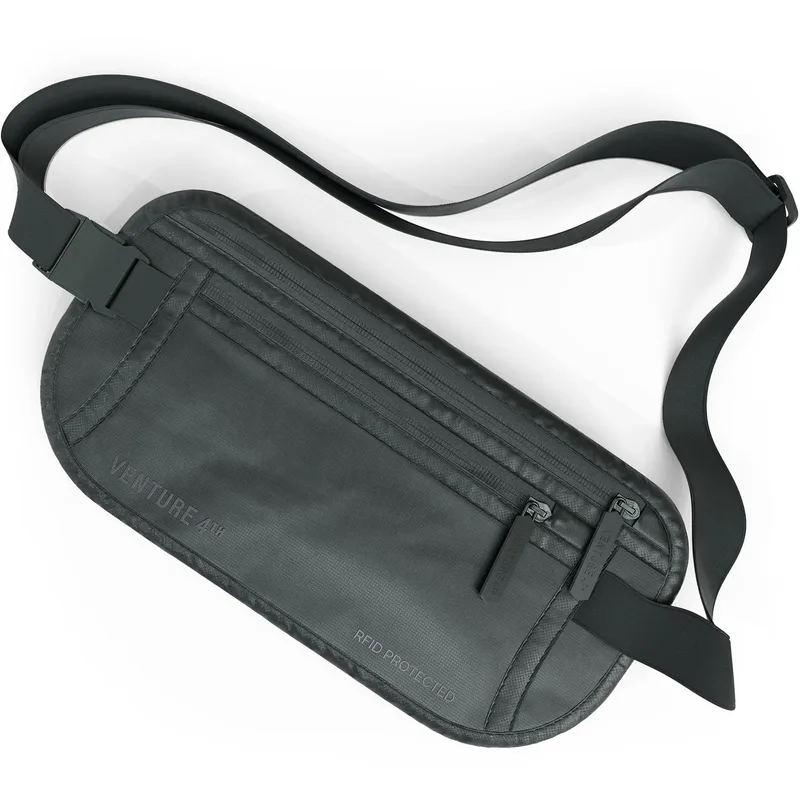
Image: Venture 4th
$24.95 — venture4th.co
The Venture 4th is positioned between the Pacsafe and the Eagle Creek in price and hits a specific brief well: it has RFID blocking and a 0.2-inch profile (only marginally thicker than the Cashsafe) in a 210D ripstop nylon construction with reinforced seams. It fits waists up to 56 inches and has a breathable mesh back that reduces sweat on warm days.
The Lifetime Replacement Guarantee is the stand-out feature at this price point: Venture 4th replaces the belt if anything goes wrong, no time limit.
If the Pacsafe is sold out or you want RFID blocking without paying Eagle Creek prices, the Venture 4th is the alternative I would choose.
Check price at Venture 4th
Best stretch design: Lewis N. Clark BeSafe Datablock Slimline Waist Belt
~$19.99 — available at major luggage retailers
The BeSafe Datablock takes a different approach: it is made from multi-stretch spandex with no buckle at all. The result is a belt that sits flush against the body regardless of posture change and leaves no visible buckle outline under a fitted shirt. RFID blocking is built into the fabric.
It is designed to be worn across the front, side, or back of the waist and is quick-dry, which matters on long travel days in warm climates. It holds ID, a few cards, and folded cash — not a passport — which is a real limitation if your priority is document security.
The Lewis N. Clark Slimline is the right pick for travelers who find all buckle-based belts uncomfortable or who need a belt invisible enough to wear under a dressed-up outfit.
How to use a money belt correctly
Keep it simple: one backup card, emergency cash, and your passport (or a passport copy). Put your phone, daily spending cash, and one card for the day in a front pocket or zippered bag pocket you can reach easily. The money belt is your last line of defense, not your everyday wallet.
Wear it under your base layer, not over a t-shirt. Against skin, or between skin and a base layer, is the intended position. Worn on top of a shirt the profile shows through most fabrics.
Practice accessing it before you need to. Finding the zipper under two layers in a crowded arrival hall is harder than it sounds the first time.
FAQ
Are travel money belts worth it?
Yes, for destinations with high tourist-targeted theft. European transport hubs, Southeast Asian night markets, and crowded South American cities are where money belts pay for themselves. In low-risk destinations they are mainly peace of mind.
Can I wear a money belt through TSA?
Yes, if it has a plastic buckle or no buckle. A metal buckle will trigger the detector. The Pacsafe Cashsafe, Eagle Creek Undercover RFID, Venture 4th, and Lewis N. Clark Slimline all have plastic or elastic-only designs that clear most scanners without removal. Always check the specific buckle material before traveling.
What is the best money belt for foreign travel?
The Pacsafe Cashsafe at $19.95 is the best starting point: thin, metal-free, and built to last. If you want RFID blocking added, step up to the Eagle Creek Undercover ($35) or the Venture 4th ($24.95).
Are money belts effective against pickpockets?
Yes. A thief targeting a tourist depends on speed and distraction — reaching under clothing to an invisible zipper is not part of that. The main failure mode is wearing the belt incorrectly (over clothing) or putting everything in it and then having to access it visibly in public.
The bottom line
The Pacsafe Cashsafe Anti-Theft Travel Wallet Belt at $19.95 is the pick for most travelers: the flattest profile, no metal for airport security, and a price that makes replacing it after years of use uncomplicated. If you want RFID blocking on top of those features, the Venture 4th at $24.95 adds it for five dollars more. The Eagle Creek Undercover is the right answer if you want a brand with wide retail presence and don’t mind the premium.
All four are worth buying. None of them are worth not wearing.
For a full rundown of what to carry versus what to leave in the hotel safe, see the travel packing security guide.