Best Travel First Aid Kit: 5 Picks From a $8 Tin to a Trauma Bag
Verdict:The Adventure Medical Kits Smart Travel ($74.99) is the best travel first aid kit for most trips: wound care plus the actual medications travelers reach for — pain relievers, an antihistamine, anti-diarrheal, antacid, and oral rehydration salts — organized by injury. The Welly 24ct tin ($7.99) covers city trips for pocket change; My Medic's MyFAK Mini ($114.95) is the serious road-trip option.
Nobody plans the headache that lands mid-flight, the blister that opens on day two of a walking city, or the street-food gamble that doesn’t pay off. A travel first aid kit is the cheapest insurance in your bag: the difference between a five-minute fix in your hotel room and a 10 p.m. hunt for a pharmacy where you can’t read the labels.
The catch is that “first aid kit” spans everything from a tin of bandages to a tactical trauma bag, and most of the kits flooding marketplaces are mystery-brand pouches with padded item counts — fifty alcohol wipes is not fifty pieces of preparedness. The five kits below come from brands that publish real contents lists, and I verified every price and spec against the brand’s own product page this week.
Some links in this review are affiliate links. Intastravel may earn a small commission at no extra cost to you. It does not change which products we pick.
What a travel kit needs that a home kit doesn’t
Medications, not just bandages. Cuts are easy to improvise around; a 2 a.m. fever in a foreign country is not. The CDC-style travel kit logic is meds-first: pain and fever relief, an antihistamine, something for diarrhea, something for stomach acid. Only one kit on this list takes that seriously out of the box.
A size you’ll actually pack. The best kit is the one that’s in the daypack when the sidewalk wins. Under a pound for most travelers; under a few ounces if you’re a one-bag packer.
Organization under stress. Pockets labeled by injury beat a zip-lock of loose gauze. You’re often using these kits flustered, in bad light, for someone else.
Carry-on compatibility. Scissors and liquids are where kits hit trouble at security — the rules are easy to meet, and covered below.
The short answer
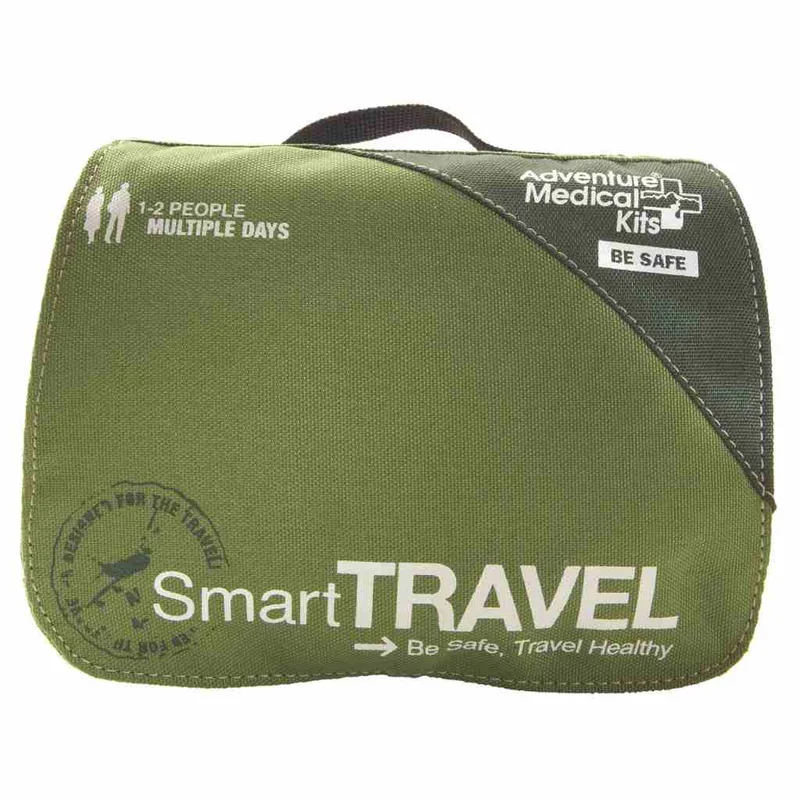
The Adventure Medical Kits Smart Travel ($74.99) is the one to buy for most international trips: it’s the only pick that treats traveler’s medications as the main event, and it’s organized by injury so you aren’t excavating in a moment of stress. The AMK Ultralight/Watertight .7 ($44.99) is the pick for one-baggers and anyone whose trips involve water. The Welly First Aid Kit 24ct ($7.99) is the no-excuses pocket tin, the Welly 130ct ($26.99) covers a family or a rental-car trip, and the My Medic MyFAK Mini ($114.95) is the overbuilt option for road trips and remote travel.
Most first aid kits are wound-care kits with a travel sticker. The Smart Travel is built backwards from what actually goes wrong on trips: it packs pain and fever relievers (ibuprofen, acetaminophen, and aspirin), an antihistamine, an anti-diarrheal, antacids, and oral rehydration salts — the exact medicine-cabinet shortlist travel clinics recommend — alongside the bandages, gauze, blister care, and antiseptic wipes everyone expects. Hospital-grade touches like bandage scissors and precision forceps mean you’re not performing splinter surgery with your fingernails.
Two inclusions justify the price on international trips. The visual communication tool is a point-at-the-picture card for describing symptoms across a language barrier, and the included Wilderness & Travel Medicine guide tells you what to actually do while you’re deciding whether this is a pharmacy problem or a hospital problem. Everything lives in labeled, injury-specific pockets — AMK’s Easy Care system — so the diarrhea medication isn’t hiding under the moleskin when you need it with conviction.
The honest knock: it’s the bulkiest soft kit here short of the My Medic, and if your travel is domestic weekends near a Walgreens, it’s more kit than you need.
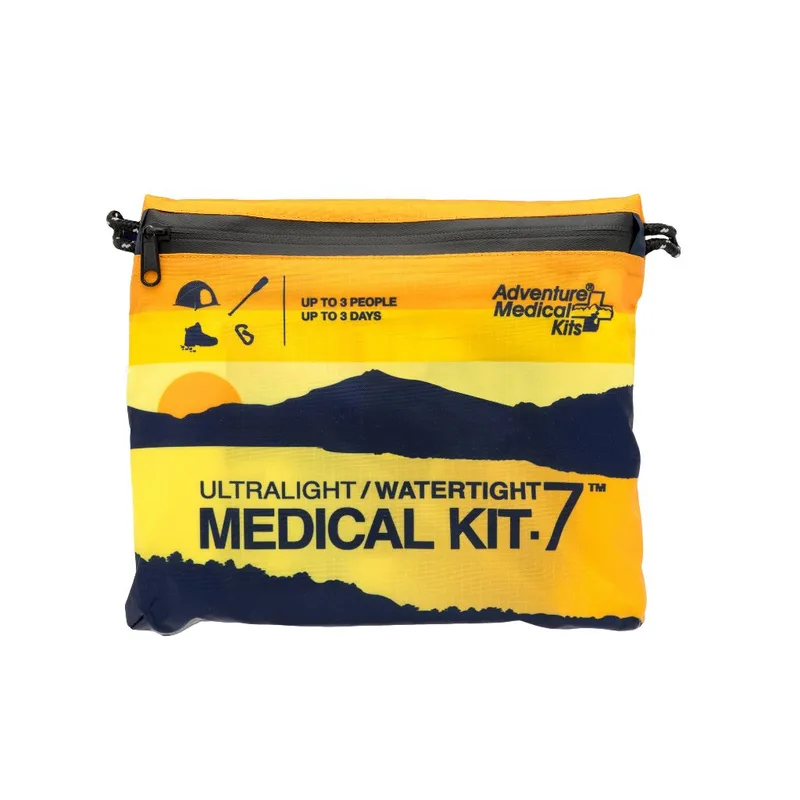
At 5.8 ounces, the Ultralight/Watertight .7 is the kit for people who weigh their luggage with a scale and their conscience. It was designed for ultralight backpacking, which makes it accidentally perfect for one-bag travel: dense, flat, and organized, with no wasted grams on a rigid case.
The signature feature is two-stage waterproofing — a fully waterproof inner bag inside a water-resistant outer — which sounds like overkill until your daypack sits through a Hoi An downpour or a kayak landing. Inside, the contents skew practical: adhesive and butterfly bandages, sterile gauze in several sizes, an elastic wrap, cloth tape and duct tape, pre-cut moleskin for blisters, pain relievers, an antihistamine, triple antibiotic wipes, nitrile-style gloves, and forceps for splinters and ticks.
What it lacks is the Smart Travel’s gut-and-fever pharmacy — no anti-diarrheal, no antacid, no rehydration salts. For international trips, bring those separately or accept the gap.
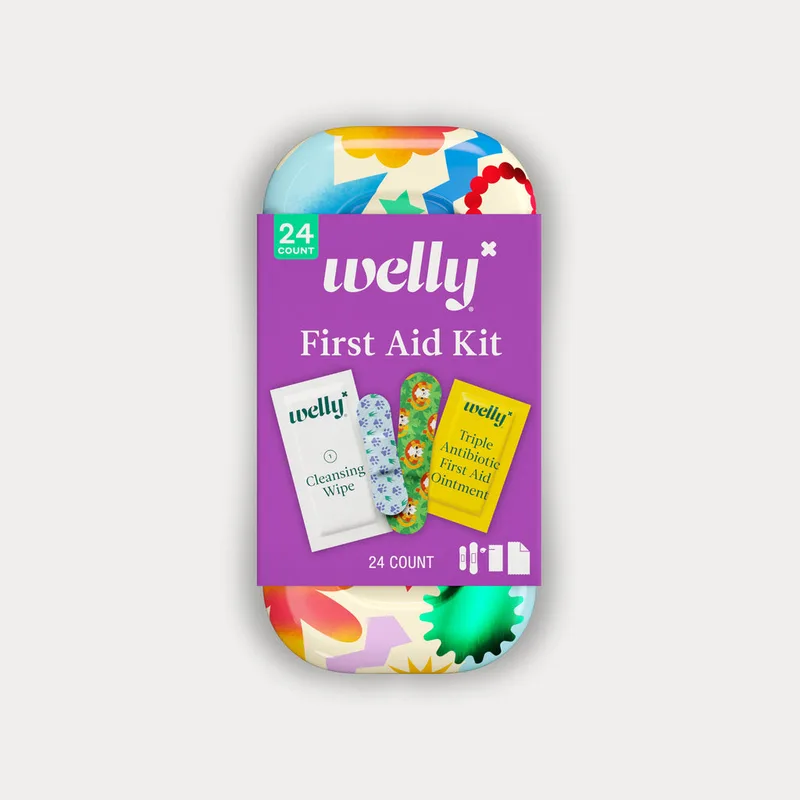
The brutal truth about first aid kits is that the comprehensive one left at the hotel loses to the tiny one in your pocket. Welly’s 24-count tin is the tiny one: 18 flexible fabric bandages in two sizes, three single-use packets of triple antibiotic ointment, and three cleansing wipes, in a slim metal tin that slides into a purse, a daypack’s hip pocket, or a jacket.
That’s the full manifest — no meds, no gauze, no tools — and at $7.99 it doesn’t pretend otherwise. What it handles is the 90% case of actual travel injuries: blisters, scraped knuckles, a cut from a scooter pedal or an oyster shell. The flex-fabric bandages are genuinely good, the kind that survive a day of walking, and the tin is sturdy enough to refill for years.
Buy it as a satellite kit to keep on your person while the bigger kit stays in the luggage — or as the only kit for a low-stakes city weekend.
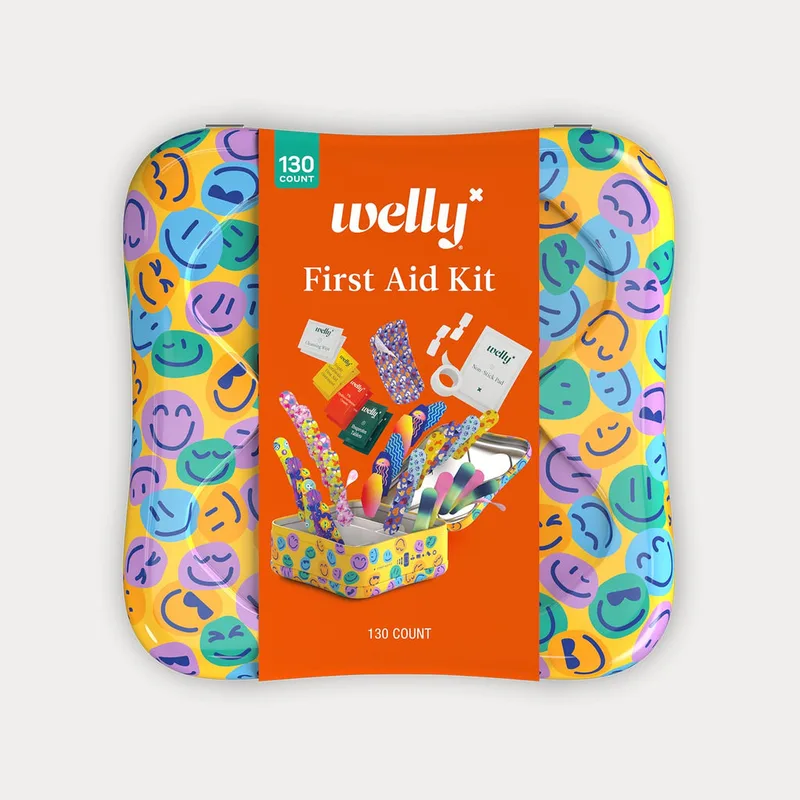
Scale the pocket tin up to lunchbox size and you get Welly’s 130-count kit: 48 standard fabric bandages plus tape, ointments, and ibuprofen, in the same cheerful reusable tin. Welly pitches it for the home, car, cabin, RV, or dorm, and that’s precisely its travel niche — it lives in the rental car or the vacation-house kitchen, where weight doesn’t matter and four people are drawing down supplies at once.
The kid math is the selling point. Children burn through bandages at a rate adults forget, partly for injuries and partly for morale, and Welly’s colorful prints are the rare first-aid item a six-year-old cooperates with. One tin absorbs a week of beach-house scrapes without rationing.
The limits mirror the small tin’s: ibuprofen is the only medication, there are no tools and no real wound-care depth, and the tin shape packs awkwardly in soft luggage. It’s the base-camp kit, not the one for your daypack.
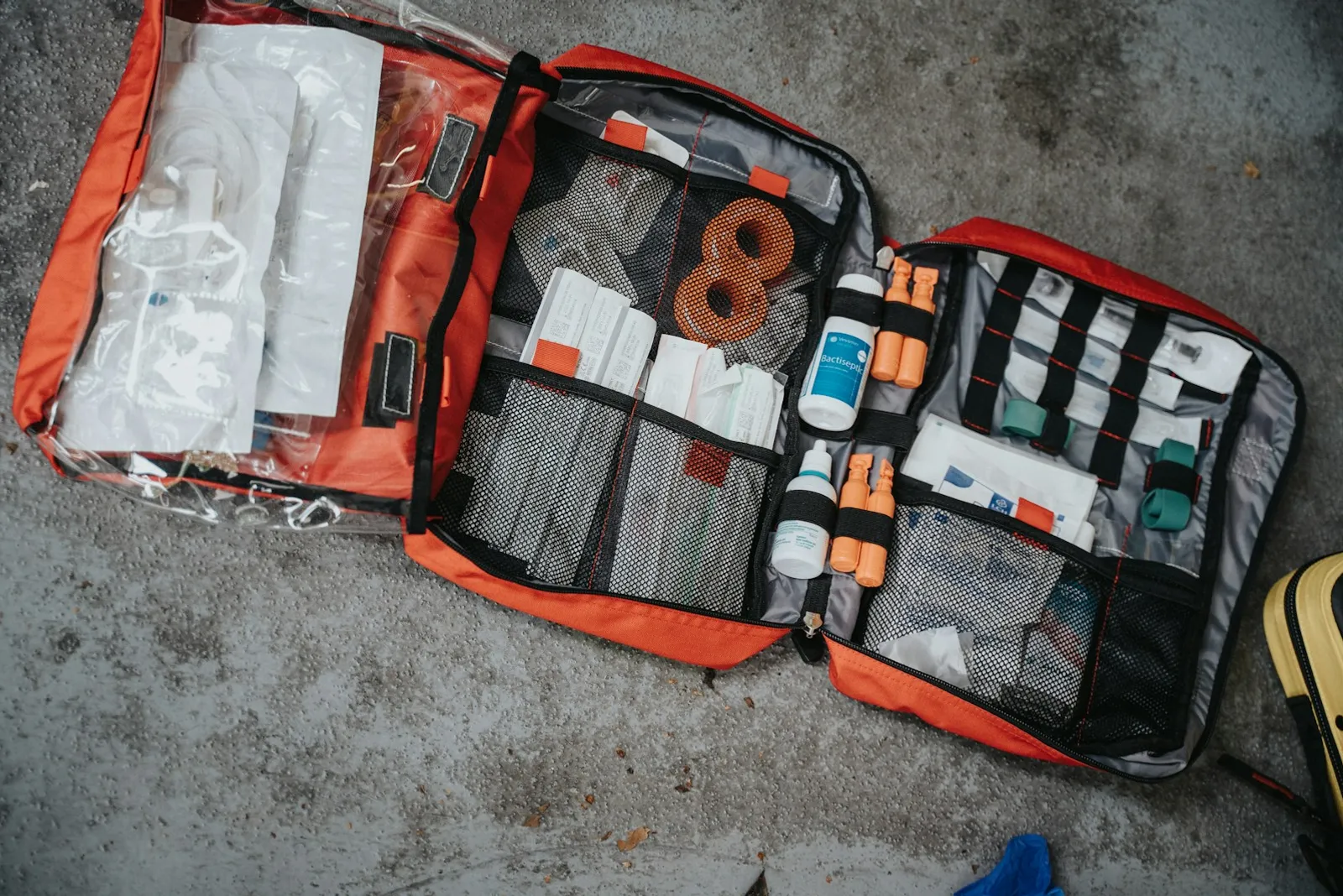
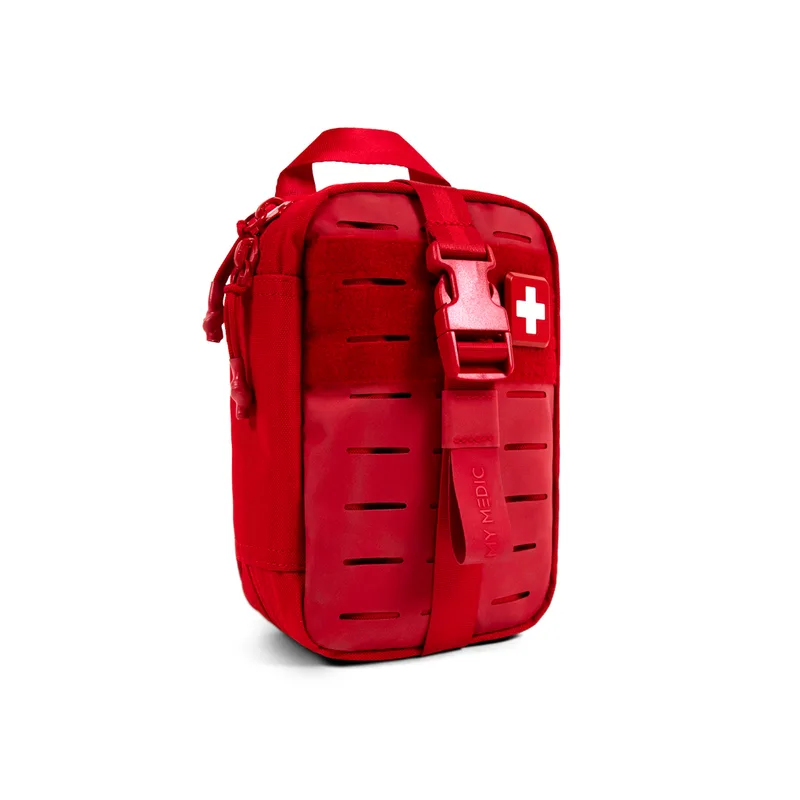
Everything above assumes your worst case is a bad stomach or a deep cut. The MyFAK Mini assumes your worst case is a car accident on a highway an hour from help. It packs 62-plus supplies into a 9 × 6 × 5-inch cube — My Medic says it comfortably covers two to three people — with a folding-page interior that opens like a book, so the thing you need is visible instead of buried. A Hypalon MOLLE panel and hidden strap let it mount to a headrest or clip to a pack, and every purchase includes My Medic’s online training course taught by a Green Beret medic, which is worth more than any single item inside.
Upgrade to the Pro ($224.95 with a RATS tourniquet, $229.95 with a windlass) and it crosses into genuine trauma-kit territory. For flights, know what you’re carrying: at two to 2.7 pounds it’s the heaviest kit here by a wide margin, and it’s happiest living in a vehicle, an RV, or the bottom of a big duffel on trips where the nearest clinic is a long drive away.
First aid kits are carry-on legal, but two contents trip screeners, and the rules — per TSA’s medical items guidance and scissors rule, both checked for this guide — are simple:
Scissors fly in a carry-on only if the blades measure less than 4 inches from the pivot point. The bandage scissors in kits like the Smart Travel pass; full shears don’t. In checked bags, sharp tools should be sheathed or wrapped.
Liquid and gel medications over 3.4 oz are allowed in carry-ons when medically necessary, in “reasonable quantities for your trip” — but you must declare them to the officer at the checkpoint. Standard kit items like single-use ointment packets fall well under the limit anyway.
Pills are fine in carry-on and checked bags; TSA recommends keeping medication labeled to speed up screening.
As with everything at a checkpoint, the final call rests with the TSA officer — another reason a tidy, organized kit beats a bag of loose supplies.
If you decant kit liquids into your own containers, our silicone travel bottles review covers the leak-proof options that pass the same screening.
Make any kit yours
Every kit above ships generic; ten minutes makes it specific. Add your prescription meds in labeled packaging, a card listing allergies and blood type, and the handful of things brands can’t legally pre-pack everywhere — your preferred motion-sickness and sleep remedies. Long-haul flyers managing swelling should look at our compression socks for flying guide, which handles the circulation side of the same “land feeling human” problem. And if your toiletries and first aid share a bag, a hanging toiletry bag keeps the kit findable instead of fossilized at the bottom.
Restock the day you get home, not the day before the next trip — the kit you drained in Lisbon is the kit that fails you in Oaxaca.
FAQ
Do I really need a first aid kit for city travel in developed countries?
Need is strong — pharmacies exist. But the Welly tin costs $7.99 and weighs nothing, and the realistic payoff is time: a blister fixed on a park bench instead of a 40-minute detour hunting a farmacia that’s closed for lunch. For remote travel, the calculus flips from convenience to genuine safety margin.
Can I bring a full first aid kit in my carry-on?
Yes. Bandages, gauze, tools, and pills screen without issue; the two watch-items are scissors (under 4 inches from the pivot) and liquids over 3.4 oz (allowed if medically necessary and declared). Every kit in this guide is carry-on compatible as sold.
What medications should a travel first aid kit include?
The travel-clinic core: a pain/fever reliever, an antihistamine, an anti-diarrheal, an antacid, and oral rehydration salts for international trips. Of the kits here, only the AMK Smart Travel includes all five out of the box — with the others, add them yourself.
Is an expensive kit like the MyFAK Mini worth it over a cheap one?
Only if your travel matches it. Its value is trauma supplies, vehicle-mountable organization, and included training — meaningful on road trips and remote itineraries, wasted on a weekend in Chicago. Match the kit to the distance between you and the nearest clinic, not to the scariest thing imaginable.
The best earplugs for flying depend on your problem. Loop Quiet 2 for noise and sleep, Mack's Flightguard or Alpine FlyFit for ear pressure.
Verdict: Loop Quiet 2 ($24.95) is the best earplug for flying if cabin noise and sleep are your problem. Mack's Flightguard ($11.99) and Alpine FlyFit ($16.95) are the picks if your ears hurt on descent, because they are built with pressure-regulating filters.
The best travel blanket for most people is the 0.79 lb Rumpl Travel Puffy. Three picks compared on weight, price, and warmth, plus a scarf trick.
Verdict: The Rumpl Travel Puffy ($89.95, 0.79 lb, packs to 4 by 10 inches, 3-year warranty) is the best travel blanket for most people. Cocoon's COOLMAX blanket ($49.95) is the cheaper, lighter-feeling pick, and Cocoon's merino and silk blanket ($149.95) is the one for the coldest cabins.
The best luggage scale for most travelers is the $10.99 Etekcity EL11. Five scales compared on capacity, price, battery, and who should skip each.
Verdict: The Etekcity EL11 ($10.99, 110 lb capacity, 4.8 oz, 2-year warranty) is the best luggage scale for most travelers. Freetoo is the lighter runner-up, Samsonite is the pick if you want a built-in tape measure, and the battery-free Travelon is for people who never want to replace a battery.